Sec.2-Ch.2-Subsec.5:Multivariate Meta-Analysis and Meta-Regression in R
Statistical Foundations, Three-Level Random-Effects Models, and Real-World Clinical Case Studies


In medical research, a single trial is often insufficient to comprehensively evaluate the effectiveness of an intervention or the progression pattern of a disease. This is because each study typically has a limited sample size, and differences in research design, intervention intensity, and measurement methods may lead to inconsistent results.
To obtain more reliable conclusions, researchers usually apply Meta-analysis to statistically synthesize results from multiple independent studies and infer an overall effect. However, traditional Meta-analysis typically focuses on a single outcome variable and ignores the dependence that may exist among multiple correlated effect sizes reported within the same study.
To address this limitation, Multivariate Meta-Analysis (MVMA) was developed. MVMA can simultaneously synthesize multiple correlated outcomes while accounting for between-study heterogeneity and within-study effect correlations. This provides more accurate and reliable overall effect estimates for clinical and public health research.
I. Understanding Multivariate Meta-Analysis
In medical and social science research, researchers frequently encounter a common yet complex phenomenon: multiple independent studies often exist for the same research topic. For example, when researchers aim to evaluate the efficacy of a particular drug for a specific disease, they may find dozens or even hundreds of clinical trials or observational studies with published results. Each study may differ in sample size, study design, measurement methods, intervention intensity, and follow-up duration, making direct comparison or simple aggregation of results difficult.
Traditional Meta-analysis methods typically treat these studies as independent units, using statistical methods such as weighted averaging to pool effect sizes and obtain an estimate of the overall effect. These analytical methods played important roles in early evidence-based medical research, helping researchers extract more reliable, generally applicable conclusions from scattered studies—for instance, clarifying a drug’s therapeutic effect on a disease or its degree of risk reduction. However, reality is often much more complex than such simple aggregation. Individual studies often contain multiple effect sizes, possibly because studies used multiple measurement tools to assess the same indicator, conducted measurements on different population subgroups, or performed repeated measurements at different time points. Each effect size contains certain information, but these effect sizes are not completely independent; instead, they exhibit correlations or dependencies. If this correlation is ignored, traditional Meta-analysis may underestimate standard errors or misjudge the significance of overall effects, leading to inaccurate or biased conclusions.
It is against this backdrop of complex data structures that scientists developed a new statistical method—Multivariate Meta-Analysis (MVMA)—to synthesize estimation results for multiple related parameters across different studies, thereby comprehensively characterizing the multidimensional associations between exposures and health outcomes. MVMA can not only synthesize results from multiple studies but also handle multiple effect sizes within individual studies and their dependency issues, providing researchers with more refined and reliable analytical tools. Through multivariate Meta-analysis, researchers can obtain more accurate estimates of overall effect sizes while accounting for dependencies among effect values, and can also explore potential moderating factors and sources of heterogeneity, thereby advancing Meta-analysis from simple aggregation to complex data parsing and further enhancing the quality and scientific rigor of evidence-based research.
The core concept of multivariate Meta-analysis is “hierarchical” or “nested” structures. From a statistical perspective, data from each study is not a single plane but a complex structure composed of multiple levels. Taking the random-effects model as an example, it is essentially a multilevel model: the first level consists of participants or individual samples, and the second level consists of the studies themselves.
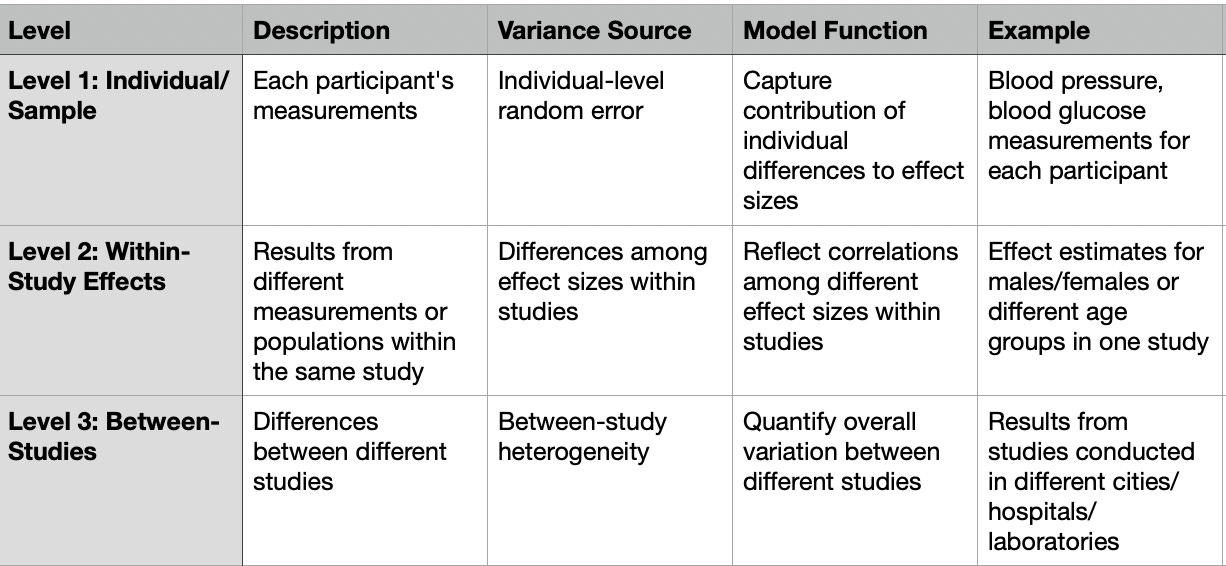
At the first level, each participant’s measurements produce certain random errors due to individual differences; at the second level, differences between different studies introduce between-study heterogeneity. Random-effects models can estimate overall effect sizes and their uncertainty by simultaneously considering these two sources of error. This means that even when we use only summary averages from each study in Meta-analysis, the model implicitly reflects the multilevel structure. If we further complicate this, when a study contributes multiple effect sizes—for example, results obtained from different populations or different measurement tools within the same study—these effect sizes are nested within the same study, forming a third level. The Three-Level Model is specifically designed to handle such situations. By introducing a third level, the model can not only reflect differences between studies but also capture correlations among effect sizes within studies, making the overall analysis closer to the true structure of the data.
Specifically, variance at the first level reflects sampling error at the participant level, variance at the second level measures differences among effect sizes within studies, and the third level quantifies between-study heterogeneity. Such hierarchical structures enable the model to clearly identify the contribution of different levels to total variation while estimating overall effects, avoiding biases that arise from ignoring dependencies.