Sec.2-Ch.2-Subsec.6:A Practical Guide to Bayesian Diagnostic Meta-Analysis in R(I)
A Practical Guide to bamdit and MCMC Methods for Small Samples, High Heterogeneity, and Sparse Data in R

Meta-analysis is a statistical tool used to synthesize results from multiple independent studies in order to obtain more stable and reliable overall conclusions. Traditional meta-analysis commonly adopts either a fixed-effect model or a random-effects model, weighting and pooling study-specific effect sizes. However, in diagnostic test research, sensitivity and specificity are often analyzed separately, ignoring their negative correlation and between-study heterogeneity.
Bayesian meta-analysis adopts a different statistical framework, treating both data and model parameters as random variables. By combining prior distributions with the likelihood function derived from the data, it generates posterior distributions. This framework not only quantifies uncertainty but also allows the incorporation of subjective knowledge or prior research evidence when appropriate, leading to more precise and transparent analytical results.
I. Understanding Bayesian Meta-Analysis
Meta-analysis is a class of statistical tools capable of synthesizing results from multiple independent scientific studies. It allows researchers to obtain more stable overall conclusions from study data collected at different locations, using different methods, or even from different databases or literature. Meta-analysis is often considered a key component of systematic reviews, but it is important to emphasize that not all systematic reviews include meta-analysis; therefore, the two cannot be simply equated. Logically, meta-analysis is equivalent to “creating new data” under appropriate conditions because it weights and integrates effects from multiple studies and outputs a new, quantified uncertainty assessment of the overall effect.
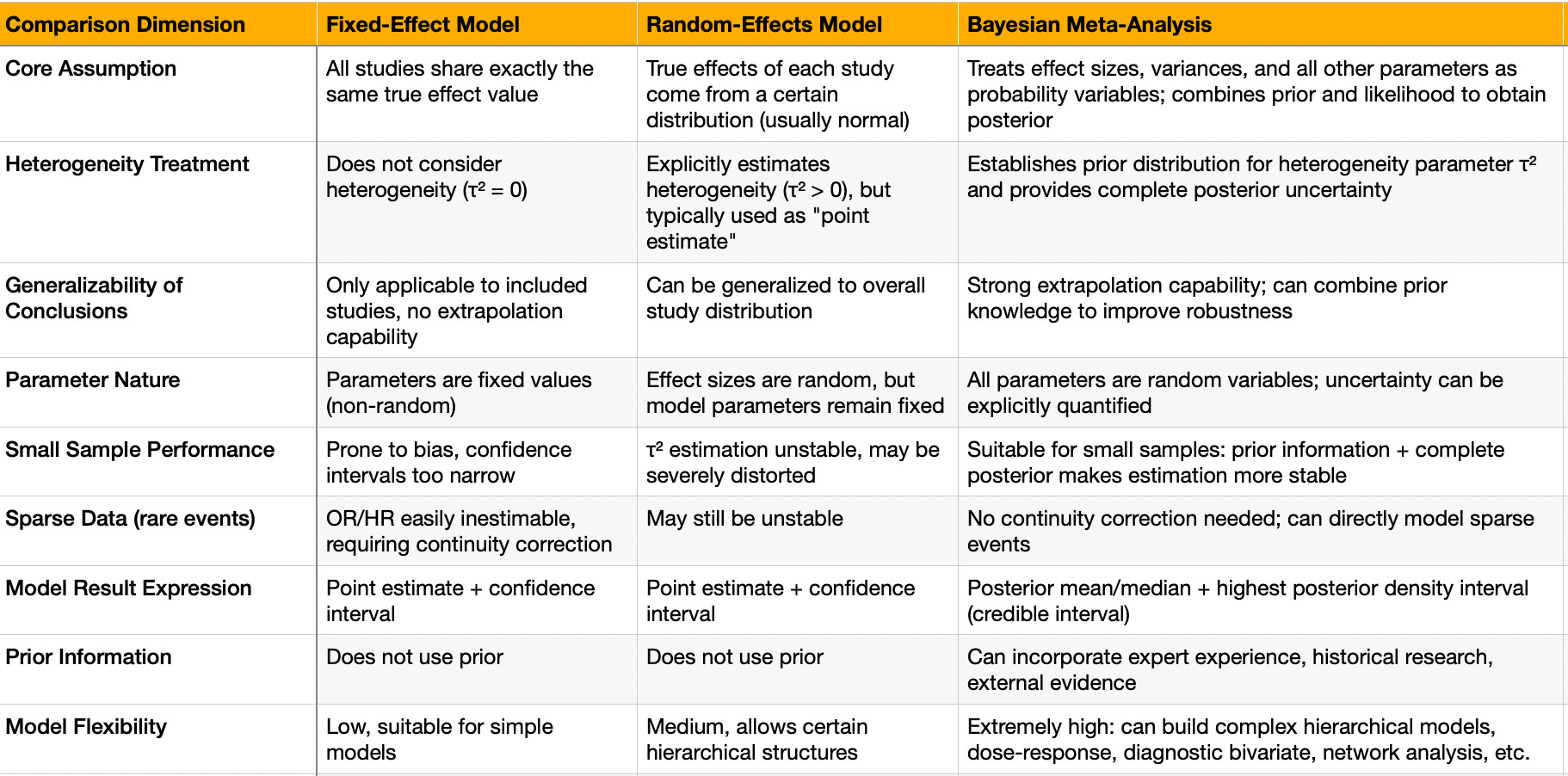
Traditional meta-analysis primarily includes two types of statistical models: the fixed-effect model and the random-effects model. The former assumes that all studies share exactly the same true effect, suitable for situations where there is no statistical heterogeneity between studies and generalization of conclusions is not required. The latter posits that there is no single true effect, but rather effect values follow some distribution across studies, making it more appropriate when the number of studies is relatively large (usually ≥ 5), study differences are apparent, or generalization to broader populations is needed. Thus, the fixed-effect model estimates “the single effect shared by all studies,” while the random-effects model estimates “the mean of the effect distribution.” This difference lays the foundation for various extended meta-analysis methods.
However, in traditional diagnostic test meta-analysis, researchers typically summarize and analyze the two indicators—Sensitivity and Specificity—separately. The core assumption of this method is that the two are independent of each other. But in reality, sensitivity and specificity often exhibit statistical correlation—improving the sensitivity of a diagnostic tool (making it easier to detect patients) is likely to come at the cost of specificity (more false positives), and vice versa. More importantly, different study designs (e.g., prospective vs. retrospective studies), patient sources (multi-center vs. single-center, different regions), diagnostic tools and operational procedures, and data quality (sample size, missing data, risk of bias, etc.) can all greatly affect the performance of sensitivity and specificity. Therefore, pooling these two indicators separately not only ignores their potential negative correlation but also fails to reveal the complexity of data structures and methodological differences between studies. Such analysis results can easily underestimate true inter-study heterogeneity, leading to misleading clinical applications.
In recent years, methods adopting a completely different statistical framework—namely Bayesian meta-analysis—have also been growing rapidly. The fundamental difference between Bayesian meta-analysis and frequentist meta-analysis lies in: Bayesian methods treat both data and model parameters as random variables. Its main task is to calculate the probability distribution of data given parameters, and on this basis construct posterior distributions, under the premise that parameters are treated as random variables. Importantly, Bayesian methods allow researchers to incorporate subjective knowledge and prior beliefs—such as previous studies, expert judgments, prior data, etc.—into the construction of parameter distributions when appropriate. Although this characteristic of “introducing subjective information” is often criticized by opponents as “subjective statistics,” in reality, the posterior distribution formed by prior information and the likelihood function is precisely the core of Bayesian inference being more precise and controllable. The posterior distribution simultaneously reflects data evidence and argumentative assumptions; therefore, Bayesian meta-analysis often provides more accurate and transparent research synthesis results than frequentist methods.
Systematic Comparison of Traditional Meta-Analysis (Fixed/Random Effects) and Bayesian Meta-Analysis